Sunday, April 21, 2013

The Deep South


Mobile Bay from Alabama Port
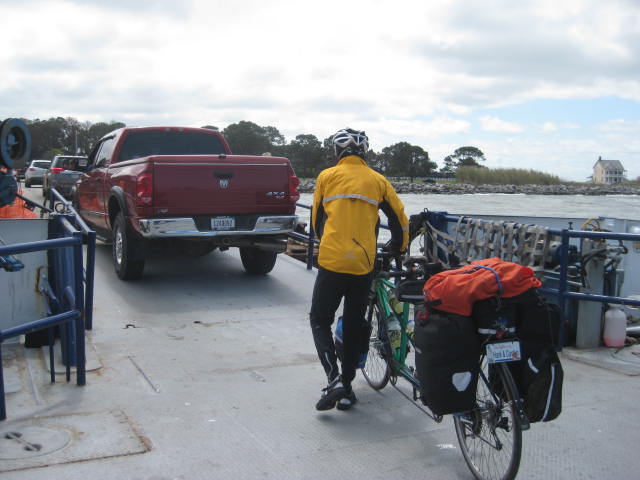
After riding out a day of heavy rain in St. Martin just north of Biloxi, the forecast improved the next day and we rode to Bayou La Batre, Alabama.   From Bayou La Batre we rode to Alabama Port and south across the Gordon Persons Bridge to Dauphin Island.  Fort Gaines on Dauphin Island on the western side of the entrance to Mobile Bay and Fort Morgan on the eastern side were important Confederate defensive positions during the blockade of Mobile Bay.  We rode to Fort Gaines about a mile east of the ferry departure point but did not have time to tour it before catching the next ferry across Mobile Bay.  From the ferry we had a great view of Fort Gaines. We also saw oil rigs inside and outside the entrance to Mobile Bay.   On the ferry we had an opportunity to talk with a number of locals and learn more about Mobile and surrounding area.  We exited the ferry at Mobile Point and toured Fort Morgan.  The fort had multiple lines of defense with overlapping fields of cannon fire.  In many respects it was very similar to one of the forts we toured in France a few years ago.  


Cannon at Fort Gaines
Oil Rig in Mobile Bay
Ferry Ride Across Mobile Bay
Hank Exiting Ferry

Hotel at Orange Beach
From Fort Morgan we rode along a sandy strip of land with beach houses build on pilings 15 feet tall to allow a storm surge to flow under them.  Our hotel in Orange Beach was on the beach and we enjoyed cooling our feet in the Gulf after a long days ride. 
Cooling Our Feet in the Gulf of Mexico

Naval Aviation Museum at Pensacola
Our ride from Orange Beach to Pensacola was uneventful.  In Pensacola, we took a day off to tour the Naval Aviation Museum.  Carolyn had been looking forward to touring this museum since we initially planned our route and thoroughly enjoyed the day.  
Blue Angel's Sky Hawks

Naval Aviation Museum at Pensacola

Florida Coast East of Pensacola
From Pensacola we rode along the coast before heading inland, riding a few miles north of Interstate 10 through rural countryside, part of which was swamps and much of which was managed timber forest land where the undergrowth is burned off each year.  We passed one area where the undergrowth was burning as we rode by.


Hank and Carolyn with Al and Heidi Parker
We arrived in Tallahassee at the home of our friends Al and Heidi Parker on Thursday.  After spending a restful off day at their home on Friday, they rode with us out of Tallahassee to Monticello where we had lunch.  


Ray Charles Statue in Greenville
We left the Parkers in Monticello and rode to Greenville, where we stayed in a cottage behind Grace Manor B&B.  Ray Charles was born in Greenville and there is a statue of him in the town park.   Sunday morning thunderstorms were forecast for most of the day so we decided to spend another night in Greenville.   


Wednesday, April 3, 2013

Cajun Country


Texas Longhorn
After riding across most of Texas, we finally took a decent photo of a Texas Longhorn. 

Rice Field with Crawfish Traps
We took Saturday off in Deridder, Louisiana and on Sunday we rode to Mamou, past numerous rice fields.   This being Sunday in the Bible Belt, we had our main meal at noon, fried chicken at a gas station/convenience store/restaurant.  While at the gas station I asked about the traps in the back of an old pickup truck.  The traps were for crawfish.  For the next two days we saw crawfish traps in many of the flooded rice fields.  Mamou is known as the center for Cajun Music but on Sunday everything was closed.  The next day our plan was to ride to Simmesport but strong head winds blowing unobstructed across the rice fields slowed us down so we spent the night outside Bunkie and rode to Simmesport the following day.  On the road we passed through Chicot State Park, where we first saw cypress trees growing in a small lake. 
Cypress Tress

White Hall Plantation House
The motel in Simmesport was less than pleasant and we were glad to leave, walking across a bridge with no shoulders over the Atchafalaya River.  Much of the land east of the Atchafalaya River is protected from the Mississippi River by a 15 foot levy.  East of the Atchafalaya River we passed the White Hall Plantation, built in 1849, one of several on the route to St. Francisville. 

St. Francis Episcopal Church
We also rode past St. Stephens Episcopal Church and Cemetery.  The church and cemetery were consecrated in 1859.  The church was constructed of hand made bricks.  The stained glass windows were made in England.  The Confederate Monument was erected and dedicated in 1904.   At lunchtime we spotted a sign pointing to the Old River Landing on the riverside of the levy.  The simple restaurant was built on floatation devices and anchored by poles 20 feet high at the edge of the “Old Mississippi River”.   During one of the frequent floods along the river, the course of the river moved a few miles eastward.  Most of the structures along this section of the river are either elevated permanently or on floatation devices.  After a simple lunch and a delightful conversation with some of the locals, we continued on through New Roads and across the new bridge over the Mississippi River.
Confederate Monument at St. Francis Cemetery 
Elevated Trailer Along Mississippi River

Restaurant on Floatation Devices Along Old Mississippi River
Crossing the Mississippi River at New Roads
The ferry across the Mississippi River closed after completion of the new bridge.  The old Adventure Cycling route, which used the ferry, now bypasses St. Francisville, but we chose to stay in St. Francisville and visit some of the sites.  


Myrtle's Plantation House
The following morning we visited the Myrtle's Plantation, the site of several murders and thought by some to be haunted.  


Central Hall of Myrtle's Plantation House
Oakley Plantation House
In the afternoon we visited the Oakley Plantation House where John James Audubon worked as a tutor and drew some of his bird sketches.  Although often thought of as a naturalist, he actually shot the birds and used wires to position the birds for his sketches.  The house itself was very interesting, clearly having been built with louvers along the south facing porch for maximum comfort during the hot, humid Louisiana summers.  After a short ride to Jackson, we stayed in the charming Old Centenary Inn and enjoyed a steak dinner at a local restaurant.  The following day we rode past the Clinton Courthouse, built in1840.
Clinton Courthouse
Confederate Monument at Clinton Courthouse
Louisiana Logging Truck
Much of the route through central Louisiana is on country roads through the forests, some native and others carefully planted for timber. The lumber and paper appear to be the main businesses in rural Louisiana and we saw many logging trucks on the road.  Most of the logging trucks gave us plenty of room when they passed us but the road shoulders were littered with branches and small logs that had fallen from the truck. 


Guest Cottage in Poplarville
Our plan was to take Easter Sunday off in Bogalusa.  Unfortunately the motel and the area in general were less than pleasant, so we crossed into Mississippi and rode to Poplarville just ahead of a violent thunder, hale and lightning storm.  We stayed in a guest cottage behind a residence and were even invited by the owner for wine that evening.  We took the following day off and yesterday rode 70 miles to St. Martin, just above Biloxi.  Today it rained heavily in the morning so we stay at the motel, working on laundry, routes and the blog.  The forecast for tomorrow is improving so hopefully we can move on to Bayou La Batre in Alabama.

Saturday, March 23, 2013

On the Road Again

Mason's Construction Themed Birthday Party

We arrived at our daughter Lauren’s home outside Houston on March 3 and spent two weeks relaxing, enjoying time with our daughter, her husband and our two year old grandson.  The highlight of the visit was the grandson’s birthday parties, the first with the family and the second with about a dozen two year olds and their families.   Our eldest daughter, Janet, flew in from San Francisco to visit for a few days and celebrate Mason’s second birthday.  


Spring Foliage 
Hank spent part of the two weeks filing income taxes, planning routes for the next stage to South Carolina and trying to regain some of the 12 lbs. he lost in the first 7 weeks.  Tuesday, March 19, we were back on the road heading east toward Louisiana.   The weather has been mild and roads good and flat.  Signs of spring are everywhere.  The trees are turning green, the pollen is everywhere, and the azaleas and dogwood are blooming.  We are also seeing lots of oil pumps and oil storage facilities.  Much of eastern Texas and western Louisiana is timberland.  We have seen lots of logging trucks on the road but most of the roads have had wide shoulders so the trucks not a problem.


Azaleas and Dogwood Blooming

Roadside Flowers
East Texas Oil Well

Tuesday, March 5, 2013

Houston on the Horizon


“The sun has riz, the sun has set, and here we is in Texas yet!”

Thirty days and 970 miles after entering Texas, we arrived at our daughter’s home outside Houston on Sunday, March 3. 

After leaving the hill country we spent a planned rest day in Blanco.  We would not have been able to ride that day anyway with cold winds from the north at 30 to 40 mph, downed power lines and falling branches. 

County Seat in Lockhart
Another windy day.  Because of the crosswinds, we had to walk about a mile and half along one stretch of road with no shoulder and heavy traffic.  We stopped for lunch in Lockhart.  Lockhart seems to be doing reasonably well economically, taking advantage of its historic buildings and its proximity to Austin.  Our destination for the night was Bastrop, another historic town with a restored downtown area where we ate before riding to the motel out by a major highway with no nearby restaurants. and a large state park.  The next morning our route took us through Bastrop State Park.  Unfortunately much of the park burned 18 months ago but it did allow us to see some of the reforestation work, which is ongoing.


Burned Section of Bastro State Park
View from Hills in Bastro State Park

Scenic Ranch on Road to Burton
We decided to break the ride from La Grange to Navasota into two days, spending the night outside Burton.  The roads from La Grange to Burton went through rolling hills past cattle and horse ranches, many of which appear to be weekend retreats or retirement homes.  The scenery was close to how I envision the ideal Texas ranch (think South Fork Ranch on the Dallas series with Larry Hagman).  Because there were no restaurants near our B&B/motel, we had our main meal at noon and then toured the Burton Cotton Gin Museum.   If Texas were a nation, it would be the 6th largest producer of cotton, almost all of which is exported.  Our B&B/motel at the Nueces Canyon Ranch was on a working horse ranch.  The motel was hidden from the road by a show ring and the stables so we initially missed it and had to backtrack.  The accommodations were excellent. 
Ranch near Burton
Cotton Gin in Burton
Nueces Canyon Ranch (and B&B/Motel)
Victorian House in Navasota
March 2 is Texas Independence Day, the anniversary of Texas secession from Mexico.  At lunch we talked with some people who favor secession from the US.  We weren’t sure if they were really serious or not.


Half Way - Arriving at Lauren's
The ride from Navasota to our daughters was very pleasant with the hill climbs less steep and less frequent.  We arrived at our daughter’s to a reception of balloons, a finish line tape and a sign reading “Half Way”.  We are excited to have completed the first leg of our journey and are looking forward to two weeks off the bike.  The next installment of the blog will be after we leave our daughter’s on March 19.


Arriving at Lauren's